
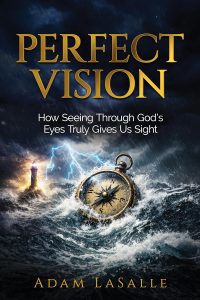
 Book Title:
Perfect Vision: How Seeing Through God’s Eyes Truly Gives Us Sight
Author:
Adam LaSalle
Publishing Information:
Best Seller Publisher, 2026
Link to Buy Book:
Synopsis:
Perfect Vision: How Seeing Through God’s Eyes Truly Gives Us Sight is a deeply personal memoir that traces one man’s journey through childhood trauma, deception, and devastating loss — including the loss of his physical sight after being shot by his own father. Yet this is ultimately a story not of darkness, but of light.
Author Bio:
Adam LaSalle is a theological researcher, author, historian, and independent scholar whose work explores suffering, discernment, and the formation of moral and spiritual vision. His writing is shaped by lived experience and guided by a lifelong commitment to Christianity as a living faith rather than a theoretical system.
Book Excerpt:
At night, the old two- story house often felt quite eerie— especially as Springfield Plantation was nestled deep in the Mississippi woods where the nearest neighbor was five miles away. As a young teen, the spooky sensation became most intense to me around 11 p. m. That’s because on school nights, I’d stand nervously at the bottom of the staircase, hesitant, because about halfway up those stairs was a window that opened into the pitch- black of those untamed woods. I would bolt past it as fast as I could, imagining the glow of fiery- red eyes watching— eyes belonging to a demonic creature ready to paralyze me with fear if I lingered too long.
Admittedly, that was the overactive imagination of a child. But nothing I imagined came close to the harsh four- year reality my brother and I would soon face. Tragically, the monster I thought lurking outside was already inside— ready to ensnare us in a cycle of deception, distortion, manipulation, and abuse.
In the summer of 1979, my thirteen- year- old brother and I— then twelve— flew from Pennsylvania, where we lived with our mother and younger sister, to visit our father at Springfield Plantation in rural Mississippi. Just a year earlier, our mother had fled that same house after enduring more than a year of abuse.
Our visit was supposed to last a month. During that time, our father was nothing but charming. As he had done to so many others, his powerful, charismatic presence and seemingly caring personality easily seduced me into doing exactly the right thing for him and exactly the wrong thing for me, without ever realizing it until it was far too late. One of his chief “ talents” was persuasion— he had a way of weaving words that could entangle and ensnare you before you ever realized what was happening.
A few days before our scheduled return from the month- long visit, he kept me up all night talking. As we watched the sunrise from the porch, I was convinced I wanted to stay there with him. Soon after, my brother decided to stay too, and we never boarded the flight home to return to where we had truly been safe.
Late that winter, my brother Carl and I were laughing in the kitchen while washing dishes when the door slammed open. Our father, Arthur, stormed in— his face twisted in rage. He had yelled before, but this was different, terribly different. Spittle flew from his mouth as he screamed, and then he hurled a large aluminum trash can across the room, sending garbage everywhere. That satanic sneer, the hatred in his eyes— it still sends a shudder through me.
It was impossible to predict what might ignite his fury. Though such explosions happened only a few times a year, the fear they created lingered far longer. There were certainly days when he was calm, even affectionate, and I clung to those moments of peace. But that only made the next outburst more disorienting. To outsiders he appeared charming, generous, even admirable. At home, the mask would drop.
His discipline came in many forms— verbal, physical, emotional— and always seemed intended less to correct than to control. Sometimes he carried a frayed leather riding crop. The memory of him striking my brother with it still makes me cringe. Life under his roof felt like navigating a field of landmines. The blow itself was not always the worst part— it was the dread of never knowing when the next explosion would come.
My father was also intelligent and exceptionally well- read. In that house he kept a vast library, and I began devouring books, encountering figures like Martin Luther King Jr., Winston Churchill, and Thomas Paine. Their words helped awaken in me a growing awareness of justice, discernment, perseverance, and courage— qualities that would become crucial in the difficult years ahead.
He was a gifted artist as well. Two large naval paintings of his hung in the house, meticulously detailed, and I often found myself admiring them. In many ways he fit the image of a Renaissance man— talented, articulate, and persuasive. Even when something felt wrong, he could still win others over with ease. These qualities became a mask, concealing the harmful person beneath.
It sickens me to remember how deeply I loved and trusted him. Though my physical eyesight was perfect, I let my feelings completely blind me.